Introduction
Many Scout Groups staged displays and performances, usually for parents and primarily as fundraisers. If friends and relatives also attended, so much the better. These early shows helped promote the Scouting ethic and strengthen links with the local community, particularly in village Groups. Plays, pantomimes, and music hall style entertainments were presented by the 1st Christleton Group and later the 4th Chester Group to raise funds for their headquarters buildings.
Records show that the 1st, 2nd, 3rd, 6th, and 8th Chester Groups all staged performances, often referred to as Parents’ Evenings, to raise money for camping equipment or to help subsidise the cost of camps. These events took place before the first London Gang Show in 1932 and therefore did not follow the Gang Show format. It was the leadership of Ralph Reader, together with the material he wrote and published, that later inspired a new style of Scouting entertainment.
During the 1950s, the 1st Christleton and 2nd Chester Groups combined to present shows known as Scout Pie at the Christleton headquarters. Part of the proceeds helped fund the sending of Scouts to a forthcoming Jamboree in Canada. Christleton also staged pantomimes, including Cinderella, Dick Whittington, and Robinson Crusoe, sometimes in cooperation with the 35th or the 2nd Chester Groups. Similar productions were mounted by the 8th, 18th, and 35th Chester Groups.
In the 1960s, the 1st Tarporley Group, under the leadership of Group Scout Leader Richard Humble, presented a three night show as a fundraiser for their new headquarters. The programme was based on the Chester Gang Show, Scoutabout. This format was revived in 1975 by Scout Leader Tim Enfield, combining the show with an awards evening and the Group Annual General Meeting. Held in the High School Hall, it was consistently full to overflowing and continued to be staged until at least 1997. A similar fundraising show was produced by the 25th Chester Group in 1977 at St Paul’s Church Hall, Boughton.
Nutcracker in 1938
In 1938, the 8th and 13th Chester Groups joined forces to stage a Gang Show style production entitled Nutcracker. The show ran for three nights at the College School on Parkgate Road and was produced by Leslie Brooks, Group Scoutmaster of the 13th Chester. It was intended as a pilot for a future District Gang Show, but the threat of, and subsequent outbreak of, the Second World War brought these plans to an end.
The First Chester Gang Show in 1953
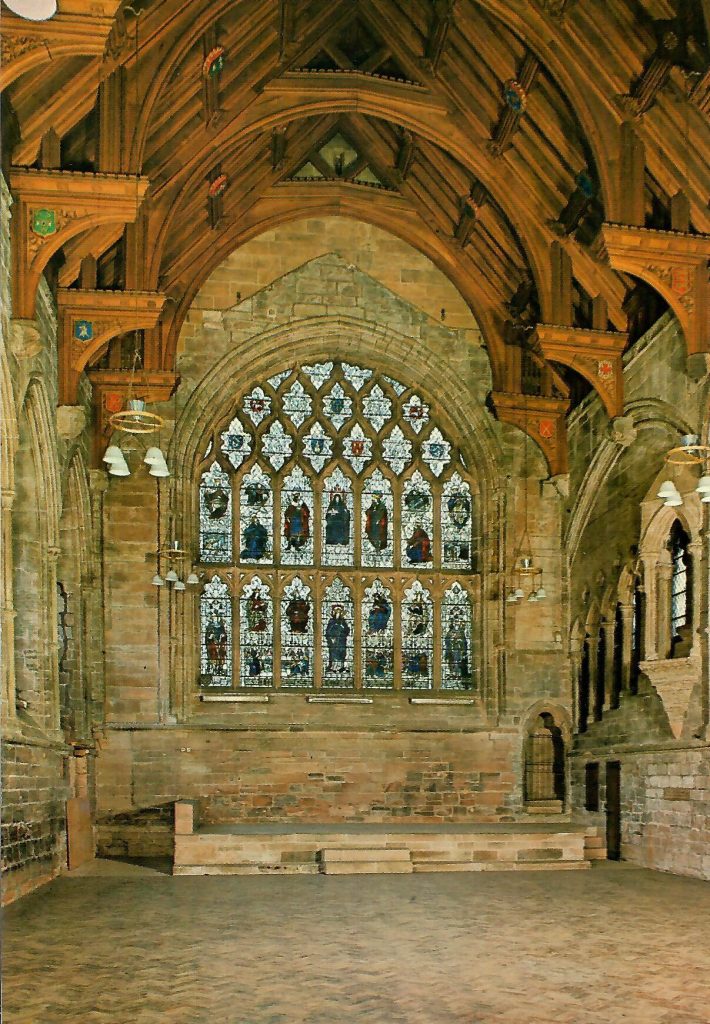
The London Gang Show, devised, written, and produced by Ralph Reader, was revived in 1951. A group of leaders from the 8th and 13th Chester Groups attended a performance and were so inspired that they decided to stage a similar production locally. The combined strength of the two Groups provided a cast of 112, together with the necessary stewards and stage staff, without involving the Cub Scouts. Rehearsals began in 1952 at the College School hall.
The resulting production was staged at the Cathedral Refectory on 16 and 17 January 1953, with three performances in total. Proceeds were donated to the King George VI Memorial Fund. The success of the show led to the 1st Upton Group being invited to join the cast, and the 1954 production ran for five nights. That year also marked a significant development, as well known local musician Bill Brickland and his orchestra were engaged to provide the musical accompaniment, replacing the two pianos used previously.
We move to the Royalty Theatre
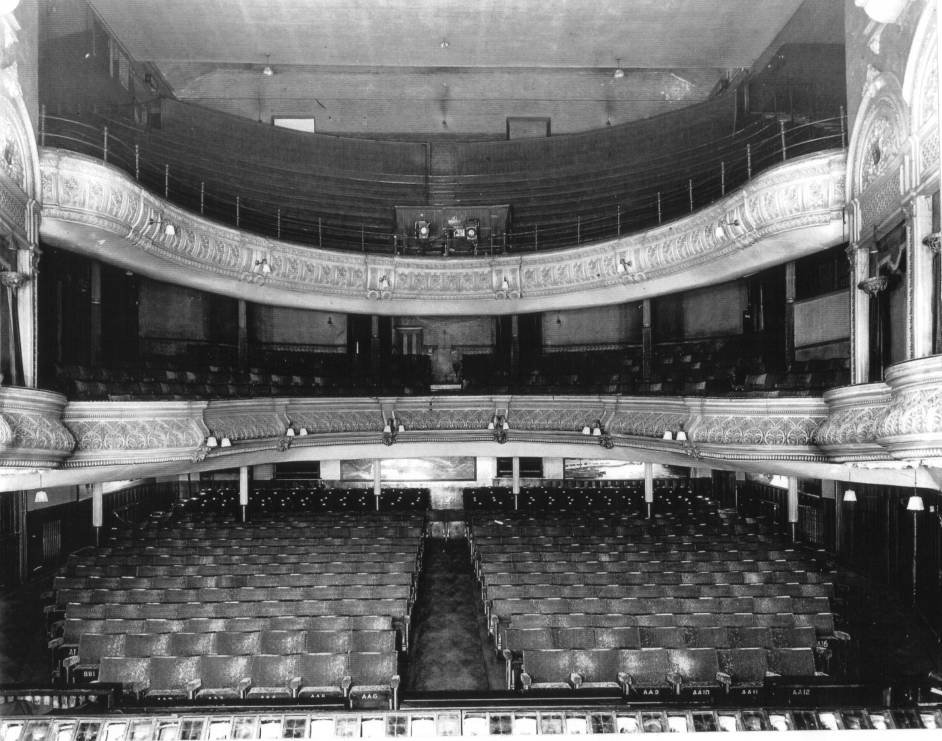
The success of the third show was such that the District assumed responsibility for future productions. It was decided to involve all Groups across Chester and District and to take the bold step of hiring the Royalty Theatre. The first fully District Gang Show, Scoutabout 1956, was staged there on 10 December with a cast of 128 and ran for one week. Eighteen members of the Gang were Cubs who, for the first time, presented their own item. This was produced by the Assistant District Commissioner for Cubs, Miss H. M. Smith.
There was no production in 1957 due to refurbishment work inside the theatre. The show returned in 1958, and the Royalty Theatre became the home of Scoutabout for the next eight years. Performances were always scheduled for the final full week of the year, immediately before the Christmas pantomime, which opened on Boxing Day. During this period the theatre was used during the day for pantomime rehearsals and in the evenings for Gang Show performances, meaning the Gang had to work around pantomime scenery as well as their own.
Considerable support was received from the theatre, its owner Aldennan Keyes, and particularly from the Theatre Manager, Dennis Critchley. Many of the pantomime stars also took an active interest in the Gang Show and gave it their encouragement.
Despite these efforts, economic pressures led to the closure of the Royalty Theatre in 1966. The Scoutabout Committee, along with other amateur theatrical societies, was therefore forced to seek a new home.
A New Home
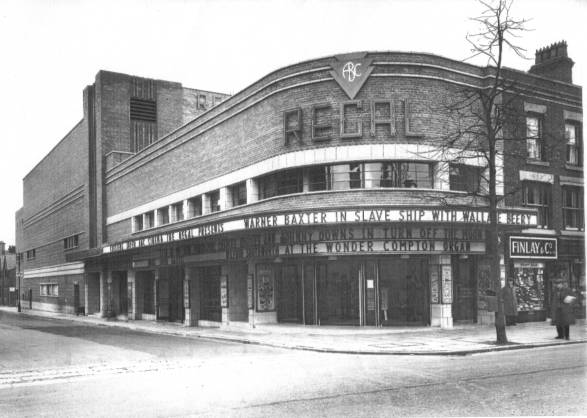
The move to the A.B.C. Regal Cinema in Foregate Street presented a number of significant challenges that required careful consideration. The rental costs were substantially higher, and with seating for 2,000 people the auditorium was twice the capacity of the Royalty Theatre. The stage, although 45 feet wide, was only 14 feet deep. There was no fly gallery, only a single backcloth rail, limited amplification, and very little dressing-room accommodation. The latter problem was solved by hiring Love Street Girls Secondary Modern School, conveniently located opposite the cinema, to provide additional space.
The final two years at the Royalty had played to sell-out audiences, and with no pantomime scheduled, it was felt there was an opportunity to fill the cinema during the first week of the New Year. Thanks to the ingenuity of the stage crew, led by Brian Whiting of Coventry, the technical difficulties were successfully overcome. The production went ahead, with the dress rehearsal held on Monday 1 January and performances running from Tuesday 2 January for five nights. The week proved successful, and it was decided to return to the Regal Cinema for the corresponding week in 1968.
Unfortunately, ticket sales in 1968 were disappointing and, for the first time, the show made a loss – £300, a considerable sum at the time. Several factors contributed to this outcome. The Chester Gateway Theatre had just opened, The Sound of Music was drawing full houses at the Odeon, a severe influenza epidemic was affecting the area, and Foot and Mouth disease had broken out on farms across the county.
Despite this setback, the Scoutabout Committee gave the show its full support and agreed that it should continue if a more suitable venue could be found. It was felt that returning to the Regal Cinema would present too great a commercial risk. A small committee: Eric France, Bill Capstick, Bill Brickland, Fred Parker (Stage Manager), and Roy Fisher (Producer) inspected a number of possible alternatives, including school and church halls, Chester College, and the College of Further Education.
The Move to the Chester Gateway Theatre
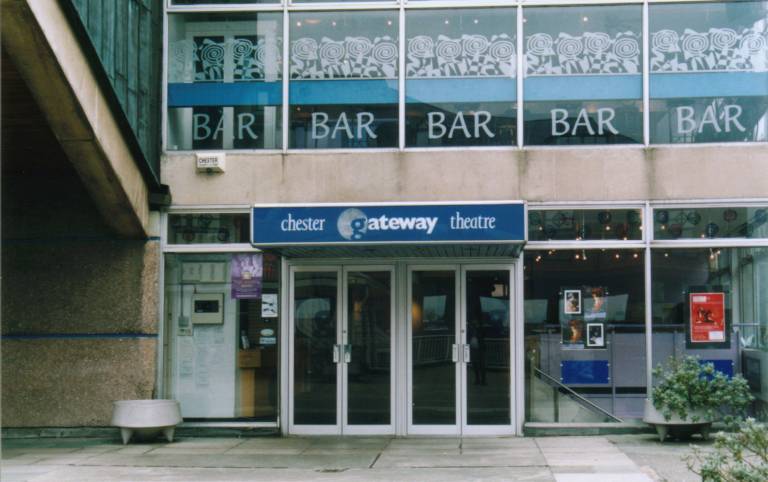
The facilities at the Chester Gateway Theatre, together with the enthusiasm and encouragement offered by Theatre Director Julian Oldfield and his staff, quickly convinced the committee that this was the right choice. The theatre was booked, and rehearsals began in the autumn of 1968 for a production in 1969.
That year marked an important milestone in the show’s history. For the first time, following the example set by Ralph Reader and the London Gang Show, girls were included in the cast—twelve in total, all of whom were warranted Cub Leaders.

In 1971, two productions were staged: one in January and another in December. Scoutabout continued to be performed at the end of December, with the Gateway’s Christmas show opening on Boxing Day. This arrangement remained in place until 1988, when the theatre—like many others—moved its Christmas season to the beginning of December. Since then, the show has been staged whenever the theatre has been available, typically between January and April, but always following the Christmas production.
During this period, much of the material originated from Ralph Reader. Following his death in 1982, this source came to an end. However, the inclusion of additional sketches from Wilcock & Rutherford, Jim Foote (well known in Gang Show circles), and other Gang Shows ensured that the production was able to continue without interruption.
Move to the King’s School
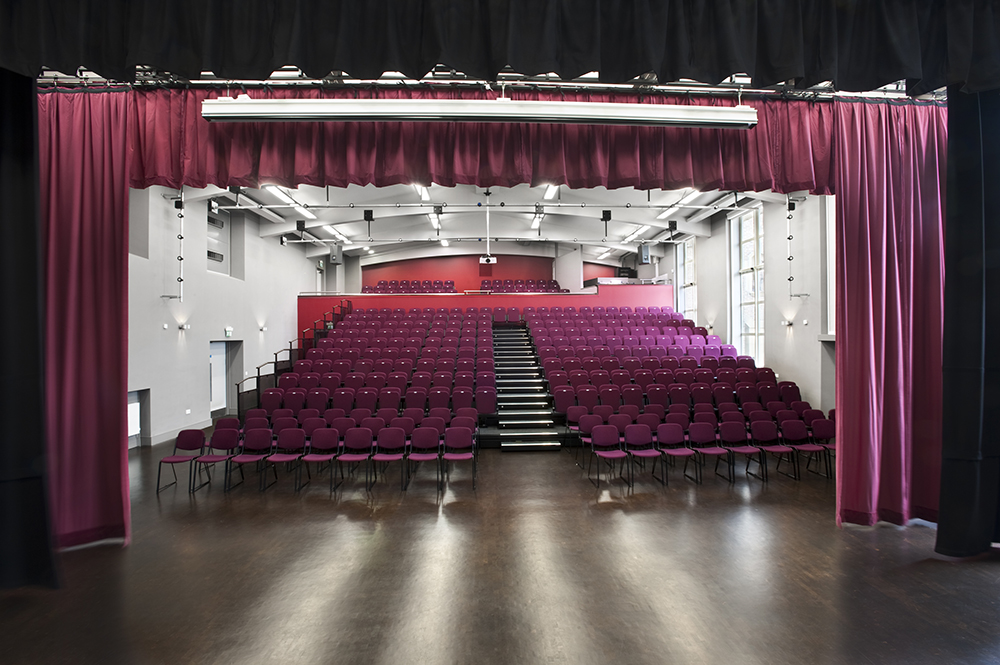
Following the closure of the Gateway Theatre, a new venue was required. In 2008, the Chester Gang Show moved to the King’s School, where the first production at the school was staged.
In 2011, the King’s School hall underwent major refurbishment and was transformed into the Vanbrugh Theatre. During this period, the Gang Show was temporarily relocated to the Catholic High School. The following year, in 2012, the production returned to the King’s School and has since been staged annually in the Vanbrugh Theatre.
The only exception was in 2021, when the show was cancelled due to the Covid pandemic.
The Producers
The first four Chester Gang Shows were produced by Leslie Brooks. Three were staged at the Cathedral Refectory and one at the Royalty Theatre. He was supported by a team consisting of Fred Cowley, Jim Rocke, John Gittins and Roy Fisher.
From 1958, production was led by Roy Fisher. His team included Colin Cresswell, Les Phillips, Ernie Boyer, Eric Wilson and Geoff Taylor. Roy remained at the centre of the show for many years and in 1979 he semi retired after producing continuously since 1958. In 1980 the newly created role of Executive Producer was taken on by Keith Musselle, who had previously been Gang Organiser. His team consisted of Derek Jackson, Eric Wilson and Roy Fisher, and together they produced the shows up to and including 1986.
Following the retirement of Keith Musselle and Derek Jackson, Roy Fisher returned in 1987 to produce the show once again. He was assisted by Eric Wilson and Eric Plenderleath. In 1991 the production team was strengthened by the addition of Richard Clarke and George Marshall. A year later, in 1992, Alison Hough and Matthew Davies joined the team, bringing youthful and more modern ideas. Lesley Pritchard and Diane Woods also assisted with the production of the Cub Scout item.
In 1995 Roy Fisher finally retired as Producer. Matthew Davies then took over as Executive Producer, adding Louise Roffey, previously the rehearsal pianist, along with Richard Clarke and Alison Horne as Assistant Producers.
After a series of very successful shows, Chester Gang Show was awarded the Gang Show Red Scarf by the HQ National Assessors in 2001, with Matthew Davies as Producer. Sadly, Roy Fisher, who had produced a total of 36 shows, died shortly afterwards in 2002.
On a happier note, the Gang Show celebrated its Golden Jubilee in 2004. This was followed by a further production in 2007, both produced by Richard Clarke. The 2007 show coincided with the seventy fifth anniversary of the first London Gang Show in 1932. Following the closure of the Gateway Theatre and the move to the new venue at the King’s School, Keith Harding became Producer. As of 2026, he has produced eighteen shows.
The Musicians
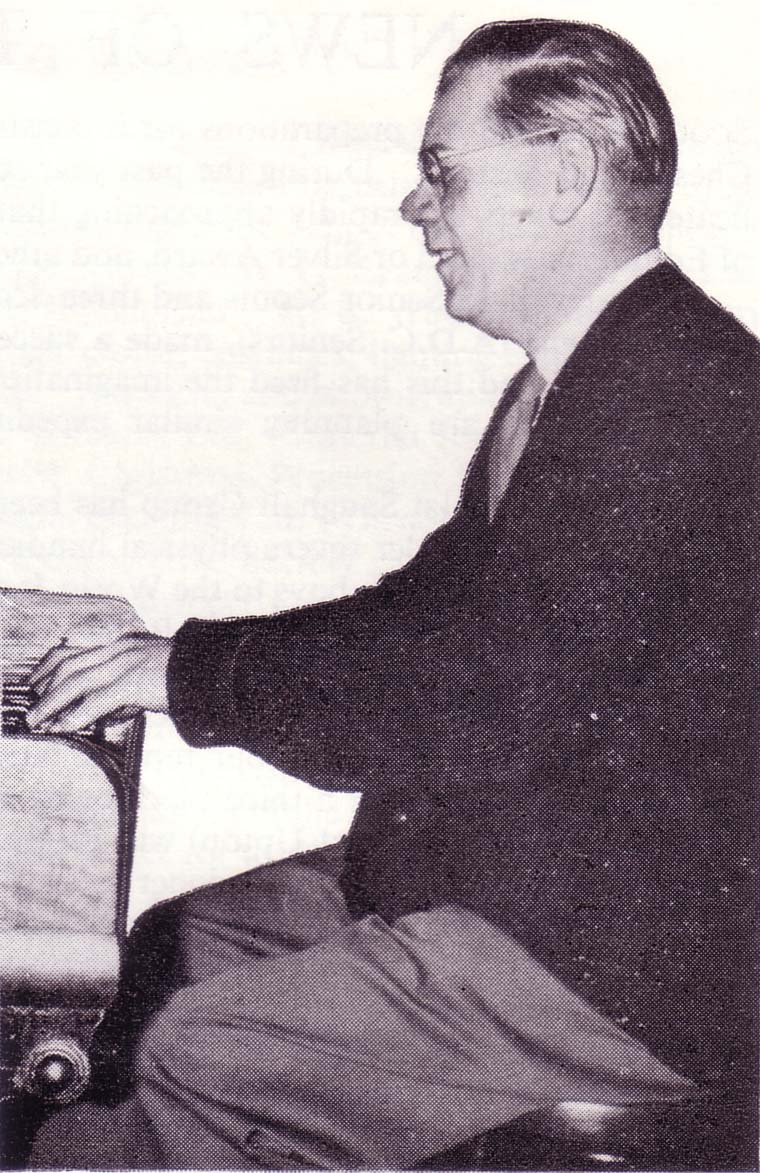
Dick Jones, Organist of the Northgate Congregational Church, and Robert Lewis, a teacher at Newton Council School, provided the music for the first show in 1953, performing on two pianos.
In 1954, Bill Brickland, a well known Cestrian and dance band leader, was recruited to orchestrate the show and to provide all the musical backing with his eight piece band. He continued in this role as Musical Director for the next twenty six years, with his final show in 1979. In 1965 he was also recruited by Coventry as their Musical Director, which in turn led to his involvement with several other Gang Shows across the Midlands. In recognition of his outstanding commitment and support, he was awarded the Medal of Merit. Sadly, due to ill health, he retired from the Gang Show scene in 1979.
For the 1980 production, Colin Parfitt took on the role of Musical Director. He has continued in this position ever since, providing the Gang Show with the same consistently high standard of musical leadership and support. During this time Colin was Head of Music at Blacon High School and frequently enabled some of his pupils to augment the orchestra. Although he initially volunteered as a temporary stand in, as of 2026 he has served as Musical Director for an impressive total of forty two shows.
Chester Gang Show Members Perform in London
In 1992, a special one off Gang Show entitled The Gang’s All Here was staged at the Wimbledon Theatre. The cast was drawn entirely from provincial Gang Shows and the production was mounted to commemorate the sixtieth anniversary of the first London Gang Show, as well as to pay tribute to the late Ralph Reader.
Chester was represented by Alison Hough, Helen Withington, Matthew Davies, and Andrew Harrop. All performed with professionalism and were a credit to the Chester Gang Show. Alison Hough was the only Scout member of the cast to perform a solo, as recorded on the video of the production.
Supported by Celebrities
Over the years, Scoutabout has received considerable support and encouragement from across the professional theatre world. Those lending their support have included Ifor Emmanuel, Billy Dainty, Gladys Morgan, Mickey and Griff, Russ Abbott, Syd Lawrence, Keith Harris, Charlie Chester, Ronnie Barker, Ken Dodd, Dame Thora Hurd, Roy Hudd, Matthew Kelly, Michael Le Vell, and Philip Schofield.
The Mayor of Chester, later the Lord Mayor, attended every production except when represented by the Sheriff. Other distinguished guests included the Dukes and Duchesses of Westminster, Lord and Lady Leverhulme, Lord Rochester, the Chief Scout, Sir William Gladstone and Lady Gladstone, and Chester’s Members of Parliament Jack Temple, Peter Morrison, Gyles Brandreth, Christine Russell, Stephen Mosley, and Chris Matheson. Every County Commissioner and Field Commissioner attended at least one performance during their tenure.
A particularly notable occasion occurred in the Millennium year, when Eric Plenderleath, a former member of the Gang and for many years the Gang Organiser, attended the performance in his official capacity as Lord Mayor of Chester.
Supported by Business
From its earliest years, the production has benefited from the generous support of local and national businesses, either through sponsorship or advertising in the show programmes. Financial risk was underwritten by Chester and District Scout Council until after the 1995 show, when District Chairman Terry Collier proposed the introduction of a formal business plan to help manage risk more effectively.
As a result, a Business Committee was established in 1996 to operate alongside the production team. The initial officers were Chairman David Lloyd, Secretary Janet Bull, and Treasurer Ron Jackson, supported by others responsible for publicity, sponsorship, and bookings. One of the committee’s first actions was to approach Marks & Spencer Financial Services, which had recently relocated to the nearby business park close to the King’s School. Their response exceeded all expectations. A substantial cash donation eliminated the previous show’s deficit and provided a surplus for future productions. In addition, their in house design team created a programme layout and template that remains in use today.
Prior to this support, and until the closure of their shops, C. C. Bounds and T. C. Burrells placed advertisements in every programme for over forty years, setting a generous precedent later followed by others, alongside donations made through the Gang Show Patrons initiative. In 2004, W. H. Evans Printers, who had produced all printed material since 1953, funded the reproduction of a facsimile of the original 1953 programme for inclusion in the Golden Jubilee souvenir programme.
By 1999, the Business Committee was fully operational and making a significant contribution to the financial stability of the show. At that time the committee consisted of Chairman Gerald Roose, Vice Chairman David Lloyd, Treasurer Ron Jackson, Secretary Pam Jones, and members including Alison Johnson, Dave King, Eric Plenderleath, and Angela James. With changes in roles and some retirements, this team remained largely intact until recent years.
The sixtieth anniversary show in 2016 marked both a high point artistically and a turning point for several long serving members of the Business Committee. Many, some aged eighty or over, stepped back from front line roles after decades of service. Gerald Roose retired as Chairman, Ron Jackson stood down after serving as Treasurer since 1996, Pam Jones retired as Secretary, and Peter Slater stepped down from Front of House duties. June Hughes, long responsible for securing programme advertising, continues in her role.
From its earliest days, the Business Committee has played a vital role in ensuring the financial viability of the Chester Gang Show, enabling it to move forward with confidence into ever more sophisticated and technically complex productions.
Early Original Text & Material by Roy Fisher
Later Additions & Revisions by Gerald Roose